
How many types of SEO are there? Depends who’s writing the listicle.
Search engine optimisation gets broken into categories, but the categories themselves aren’t standardised. Some would say three, others fourteen. Truth is, nobody agrees, and the disagreement is fine. SEO isn’t an official taxonomy. It’s a working set of practices that overlap, and writers draw the lines wherever feels useful.
For most Australian business owners deciding where to invest first, the count doesn’t matter. The useful question is which type of SEO is broken on your site right now, and what fixing it would do for the business.
That has a usable answer.
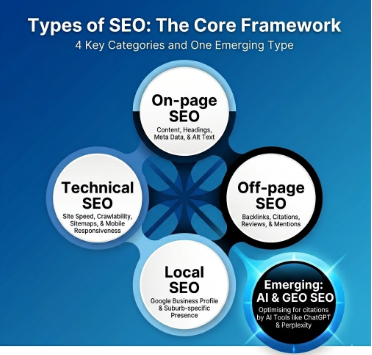
Four core types of SEO actually shape strategy: on-page, off-page, technical, and local. They’re categorised by where the work happens. On the page itself. Around it on the wider web. In the technical structure of the site. In your local search results.
Everything else you’ll see listed (image SEO, video SEO, voice SEO, programmatic SEO, ecommerce SEO, mobile SEO, even SXO and AI SEO) sits inside one of those four as a sub-practice, or it’s a newer area where the categories haven’t settled yet. The longer listicles aren’t wrong. They’re just inflated. Image SEO is a real thing. It’s also just on-page SEO applied to images. Treating it as a separate type makes the list longer.
Then there’s the ethical side, white hat, black hat, grey hat. Those describe how you do SEO, not what kind. Different conversation, separate page.
On-page SEO is everything that lives on the page. Content. Headings and internal links. Page titles. Meta descriptions. Alt text. URL structure. Anything a reader or a crawler hits when they land on the page.
You can do most of it without a developer. Rewriting a meta description takes five minutes. Restructuring a tired service page takes an afternoon. The work is judgment and time, which is why on-page is where new sites should start.
The most common failure mode isn’t laziness. It’s an intent mismatch. A plumber’s “blocked drains Sydney” page that doesn’t mention any Sydney suburbs. A law firm’s family law landing page that opens with the firm’s history instead of the reader’s problem. The page exists, the keyword is roughly right, but the content doesn’t answer what someone typing the query was actually trying to ask. Google reads the gap. The page sits on page two.
Off-page SEO is what happens around your site rather than on it. Mostly, it means backlinks, when other websites link to yours. It also covers brand mentions, citations on directories, reviews, and social signals.
Backlinks still matter most. They also still get misunderstood the most. Businesses chase volume, more links, faster, from anywhere. The reality is that one link from an industry publication that genuinely covers your space is worth fifty from low-rent directories built to game search engines. Google can spot the difference now. Buying cheap links is how established sites get penalised.
If your on-page is sorted and the technical work is clean, and you’re still being outranked by sites that look weaker than yours, the gap is backlinks. Building a real backlink profile takes months. You can’t speed that up.
Picture a Melbourne law firm with strong content, a clean brand, and decent traffic, but rankings that won’t move past page two no matter what they publish. That’s technical SEO territory. To a human visitor, the site looks fine. To Googlebot, half the pages load slowly, the canonical tags point the wrong way, and a JavaScript framework is hiding the main content from indexing.
Technical SEO is the part of optimisation that the customer never sees. Site speed. Mobile responsiveness. Crawlability and indexability. Structured data. HTTPS. Sitemaps. URL hygiene. None of it is interesting to look at, and any of it can stop a site from ranking, even when the content is good.
Most businesses skip technical SEO because they can’t see it. They keep adding content to a site with technical problems, and the new pages don’t rank either. A site audit through Semrush, Ahrefs, or Screaming Frog is free and takes about an hour. Run it before you assume the answer is more content.
If you serve customers in a defined geographic area, local SEO is where the fastest commercial wins live.
The work isn’t complicated. Set up a Google Business Profile properly. Keep your name, address, and phone number consistent everywhere they appear online, in directories, social profiles, your website footer, the lot. Build out service-plus-suburb pages so a plumber’s site doesn’t just have a “blocked drains” page but a “blocked drains Parramatta” page, and a “blocked drains Bankstown” page, and so on for every suburb you actually want to rank in. Get reviews. Reply to them.
That’s the bulk of it. Local SEO punches above its weight for Australian service businesses because most competitors haven’t bothered with the basics. A Brisbane electrician with a properly set up local presence often outranks bigger franchise outfits that haven’t done the suburb-page work.
It depends on what’s broken. Most “which type of SEO is most important” guides are unhelpful because they give you a default order without asking what’s actually wrong with your site.
The diagnosis is quick:
|
Situation |
Where the problem usually is |
|
Pages aren’t ranking despite good content |
On-page (intent mismatch or thin content) or technical (crawl issues) |
|
Pages rank for the wrong keywords |
On-page (poor keyword targeting) |
|
The site is slow or breaks on mobile |
Technical |
|
Competitors with weaker content outrank you |
Off-page (backlink gap) |
|
You don’t show up for local searches |
Local (Google Business Profile or citations) |
|
The site has been penalised |
Off-page (toxic backlinks) or content quality |
If you really need a default order, look at it first on most sites. If your content doesn’t match search intent, no amount of backlinks or schema will fix it. Technical comes after that. It’s where a lot of “should be ranking” sites are actually broken. Local SEO moves fastest for service businesses. Off-page is the slowest of the four because backlinks take time, but for some sites, it’s the only thing left to work on.
Depends on the business.
If you’re a local service operation, tradie, accountant, family lawyer, dental clinic, or anything where customers are looking for someone in their suburb or city, local SEO is the answer. Get the Google Business Profile right first. Build out service-plus-suburb pages. Chase reviews. Most of your competitors haven’t.
If you run an e-commerce or product business, on-page and technical SEO need to move together. Product pages and category pages have to match search intent, and a slow site or messy schema will quietly cap how well any of it ranks. Off-page comes later.
If you run a content-led business, consulting, B2B services, anything where the sale follows trust, start with on-page SEO and a content strategy aimed at buyer-intent keywords rather than informational ones. Backlinks come later, once the content is worth linking to.
If your site is established but plateaued, the problem usually isn’t content. It’s technical or off-page. A technical audit and a backlink review will tell you which.
The mistake we see most often is businesses chasing backlinks before fixing on-page. It rarely works. The site won’t rank for the keywords you actually want until the on-page work matches the queries you’re targeting.
For small Australian businesses with a defined geographic catchment, most trades, professional services, clinics, and retail, local SEO offers the best ratio of effort to commercial result. It moves faster than national SEO. The competition is narrower. The searcher’s intent sits closer to a buying decision.
If you don’t have a geographic focus, that calculus changes. Selling online to anyone in Australia means competing nationally. On-page and technical SEO carry more weight. Off-page becomes a longer-term build.
This is the type of SEO that didn’t really exist two years ago, and it’s where the most interesting work is happening right now.
GEO, generative engine optimisation, is the practice of optimising content so AI tools like ChatGPT, Google AI Overviews, Perplexity, and Claude actually cite it. AI SEO is a fuzzier term that means the same thing. The two get used interchangeably.
The reason it matters is straightforward. AI search isn’t replacing Google. It is, however, taking a growing chunk of informational queries, particularly questions. When a Melbourne business owner asks ChatGPT, “best bookkeeper for tradies in Australia,” the answer comes from somewhere. The sites that get cited are the ones structured for clean extraction. Direct answers in the first hundred words. Strong entity signals, location, industry, service. FAQ schema where it fits. Quotable, declarative sentences. Real depth instead of a surface skim.
Performance Marketer has been folding GEO principles into client content for the past eighteen months. Most agencies haven’t started yet. If you’re picking which type of SEO to invest in for the next two years, this is the one that’s still a competitive advantage.
The four core types stay the same across industries. What shifts is the mix.
For tradies, electricians, plumbers, appliance repair, local SEO carries most of the load. Suburb-specific service pages, a properly set up Google Business Profile, and a steady flow of recent reviews drive most of the commercial outcome. Technical SEO matters more than people think. Most trade searches happen on mobile, and a slow site loses leads before the customer reads a word.
Law firms work differently. Legal searches are mostly geographic, so the local element is there, but the on-page work is heavier. Practice-area pages have to be specific (not “family law” but “property settlement Sydney”). Content has to read as if a lawyer wrote it for a person, not as if a regulator wrote it for a checklist. Generic legal content doesn’t rank because the SERP is full of it.
Accountants and bookkeepers sit in between. Local SEO handles the geographic side. On-page handles service-specific pages, BAS, payroll, software setup, and industry-specific bookkeeping. The audience is cautious, so tone matters. Calm, specific writing converts better than punchy marketing copy with this audience almost every time.
For e-commerce in Australia, technical and on-page SEO do most of the work. Product schema, category page optimisation, internal linking, site speed, that’s where the biggest gains are. Off-page is slower, but it’s also what protects you when the next algorithm update hits.
They’re real practices. They’re not separate types of SEO at the strategic level. They’re tactical specialisations inside the four core types.
Image SEO is the part of on-page SEO that deals with images, filenames, alt text, compression, and file format. Video SEO does the same thing for video content, with YouTube as a separate platform that has its own rules. Voice SEO is content built for conversational, question-based queries; it sits inside on-page and local. Mobile SEO is technical SEO with mobile as the priority. Programmatic SEO is a content production approach, generating large numbers of pages from a template and a database, usually for long-tail queries. It tends to suit directory or listing-style businesses more than service ones. SXO, search experience optimisation, is the conversion side of on-page.
If you’re seeing these listed as separate types alongside on-page, off-page, technical, and local, the article you’re reading was written long for the sake of being long.
These aren’t types of SEO in the same sense as the others. They describe how you do SEO, whether you’re working inside Google’s guidelines or trying to game them.
For most legitimate Australian businesses, the answer is simple. Stay white hat. Black hat tactics get penalised, often irreversibly. Grey hat carries enough risk that it’s not worth it for a business that depends on long-term organic visibility. We’ve covered that on a separate page.
The first move is figuring out what’s actually broken before deciding what to invest in. A free site audit through Semrush, Ahrefs, or Screaming Frog will surface technical issues in an hour. Google Search Console will show you which pages get impressions but no clicks, usually an on-page intent problem. If you serve a local area, your Google Business Profile is the first thing to check and the easiest to fix. Looking at where your top three competitors are getting their backlinks tells you whether off-page is the real gap.
That’s most of the diagnostics before you’ve spent a dollar.
If you’d rather have someone work through it with you, that’s what we do. Performance Marketer is a Melbourne SEO agency working with Australian businesses across trades, professional services, and ecommerce. We’d rather tell you what’s actually wrong than sell you a package.
Speak with us when you’re ready.