
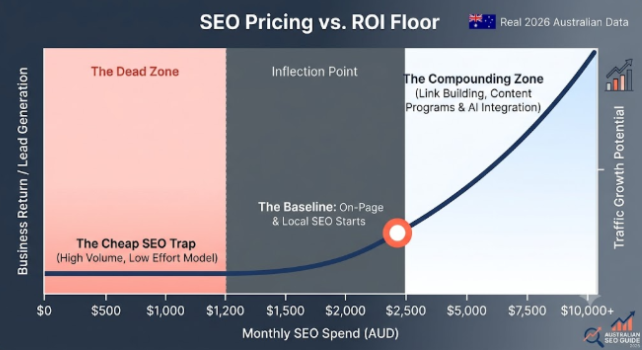
Most businesses in Australia pay somewhere between $1,200 and $10,000 a month for SEO. Where you land in that range has very little to do with an agency’s rate card and almost everything to do with what you’re actually asking them to do, and how competitive your market is.
That’s the part the pricing pages rarely spell out. Two agencies can quote you the same number for what looks like the same work, and one campaign brings in a steady run of qualified enquiries while the other does nothing for six months. Same price. Same deliverables on paper. Wildly different outcome.
So this guide does two things. It gives you honest ballpark figures for what SEO costs in Australia right now, and, more usefully, it shows you what changes between the tiers, so you can tell whether a $1,500 proposal and a $3,000 proposal are different in scope or just different in price.
Here’s the short version before we get into the details
|
Business type |
Typical monthly SEO cost |
|
Google Business Profile management |
$400+ per location |
|
Small business / local SEO |
$1,200 – $2,500 |
|
E-commerce SEO |
$1,500+ |
|
Medium / multi-location business |
$1,600 – $7,500 |
|
National or large organisation |
$2,500 – $10,000+ |
|
Enterprise SEO |
$7,500+ |
: A one-off setup or audit, with no ongoing retainer, usually sits between $2,000 and $10,000, depending on how big your site is and how many keywords you’re chasing. SEO consultants charging by the hour land roughly between $120 and $300, depending on seniority.
These are indicative, GST-exclusive, and they move with your industry. A plumber in a single suburb and a national finance brand are not playing the same game, and the price reflects that.
The honest answer: because doing it badly is cheap, and doing it well is resource-intensive.
The competition is the whole story. For any keyword worth ranking for, you’re up against thousands, sometimes millions, of pages, and the rewards are stacked heavily toward the top. The first organic result pulls a wildly disproportionate share of the clicks. By the time you’re at the bottom of page one, you’re getting a fraction of that. Page two might as well not exist.
So “ranking” isn’t a participation activity. You’re either good enough to land near the top, or you’re spending money to sit where almost nobody looks. That’s why a cut-price campaign so often returns nothing, not because SEO doesn’t work, but because mediocre SEO doesn’t.
Done properly, a single client soaks up a real chunk of skilled time each month: keyword and competitor research, content that’s actually written well, technical fixes, link building. That’s specialists, not a single generalist clicking through a checklist. Skilled time costs money. The price follows from there.
The point worth holding onto: cheap SEO and good SEO aren’t the same product at different prices. They’re different products.
There’s no magic number, and anyone who gives you one without asking about your business is guessing.
That said, there’s a floor. Below roughly $1,000 a month, it’s hard to do enough genuine work to move anything in a competitive market, so you’re usually paying for the appearance of SEO rather than the result. Agencies operating at that price almost always run a high-volume, low-effort model: lots of clients, very little time on each.
The better way to frame the question isn’t “what’s the going rate.” It’s “what does the result need to be worth before this makes sense?” If ranking for one core search term could bring in a handful of customers a month, and each customer is worth a few thousand dollars to you, then $2,000 a month isn’t really a cost. It’s the cheapest part of the deal.
This is where most pricing guides go quiet. They’ll tell you small business SEO is $1,200–$2,500, then move on without explaining why one end of that range is double the other. Here’s the difference in plain terms.
You’re realistically getting website optimisation and not much else. On-page work, meta titles and descriptions, some internal linking, maybe light content. Decent link building is usually not included. It’s the most resource-heavy thing an agency does, so it’s the first thing that gets cut to hit a low price. Google Business Profile management often isn’t in there either, which is a problem because local businesses frequently pull half their leads or more straight out of Google Maps.
You’d expect both your website and your Google Business Profile to be optimised on an ongoing basis. Early in a campaign, the focus sits on content and internal structure; once that’s solid, consistent link building kicks in. This is the level where small business SEO starts to compound rather than tread water.
Carry an extra cost most owners underestimate: the website itself. Multi-location SEO lives or dies on how the site handles separate locations, and a lot of franchise and multi-branch sites get this wrong (one page trying to rank for every suburb, inconsistent details between the site and each profile, that sort of thing). Each Google Business Profile also needs to be managed individually, so the cost scales with the number of places you operate.
This is a different animal. You’re funding broad, sustained content programs, advanced technical SEO, schema, internal linking systems, and digital PR to earn the kind of authority that ranks across an entire state or country. The price reflects the surface area: more pages, more competition, more moving parts.
So when you’re comparing two quotes in the same band, the real question is: which activities are in scope? A $1,500 quote with no link building and a $1,500 quote with link building are not the same offer.
Australian agencies and consultants price SEO in four main ways. Most guides cover two and stop. Here are all four, with the honest trade-offs.
The default for ongoing SEO, and for good reason: it staggers the cost while the work compounds. You pay a set fee each month for continuous optimisation across content, technical, link building and reporting. Best for almost anyone who wants results that build over time rather than a one-off hit.
Expect $120 to $300 an hour, the rate climbing with seniority. For an ongoing campaign, I’d usually talk you out of it. Billing by the hour pays the agency for time on the clock, and time on the clock only loosely tracks what shows up in your rankings. It earns its place on narrower jobs: an audit, or a one-off strategy session where a few hours of an experienced head is the actual thing you need.
A fixed fee for a defined piece of work. A site audit might run $2,000–$5,000; a platform or domain migration $3,000–$10,000; a content overhaul somewhere in between. Good when you’ve got an in-house team and just need a specialist to handle one thing.
A smaller base fee plus bonuses tied to traffic, rankings, or conversions. Sounds ideal, with aligned incentives and a lower upfront cost, but there’s a catch. If the targets aren’t defined tightly, it pushes an agency toward short-term tactics that hit a metric rather than long-term health that builds the business. It works best for companies that already have solid traffic baselines and know exactly what they’re measuring.
Roughly $120 to $300 an hour. A junior or generalist sits at the lower end; an experienced SEO consultant with the depth to actually diagnose what’s wrong with your site charges toward the top.
Worth knowing: most reputable Australian agencies don’t bill by the hour at all. They quote by the job. Part of that is practical, because a single campaign might have a technical specialist, a content writer, and a link-building specialist all touching it, and it’s cleaner (and usually cheaper for you) to price the outcome than to track everyone’s clock.
Cheap SEO is cheap for a reason, and the reason is that it mostly doesn’t work. You generally get one of three things for your $100–$500 a month.
Nothing. A couple of token changes in month one, then a quiet monthly invoice while you wait for results that never come. Because real SEO takes a few months to show, this can run for a while before anyone notices.
Filler. Content written by someone with no feel for your business or your customer, often barely readable. It might even rank occasionally, but a customer who lands on it loses confidence in you before they’ve finished the first paragraph.
Risk. Cheap link building usually means buying low-quality links in bulk. Google has spent years getting good at spotting paid link schemes. At best, those links do nothing; at worst, they earn a penalty, and undoing that costs far more than you ever saved.
There’s the odd exception, a talented newcomer charging below market while they build a reputation, but expect that to be short-lived once they work out what they’re worth.
No. SEO cost per keyword is an old model that most credible agencies dropped years ago. If a proposal prices your campaign by the number of keywords, that tells you something about how the agency thinks, and it’s worth a second look before you commit. The work that actually moves rankings is about whole topics and the intent behind a search, so a campaign scoped as a list of individual keywords is usually a sign that the strategy hasn’t been thought through.
Salaries for an in-house SEO specialist in Australia run anywhere from about $70,000 up to $190,000, and at the top end, you’re paying for someone who’s genuinely senior. But salary isn’t really where the comparison lies. The trap is what you’re asking that one to hire to do.
A capable SEO agency runs keyword research, competitor analysis, technical SEO, copywriting, link building, off-site strategy and reporting, usually across several specialists. Expecting one in-house person to be excellent at all of that is a tall order, and you’re paying a full salary regardless of whether there’s a full workload every month.
For larger organisations with constant, large-scale SEO needs, in-house can absolutely make sense. For most small and medium businesses, an agency gives you a wider skill set for less than the cost of a single senior hire.
This is the part of the pricing conversation that’s genuinely new, and most guides haven’t caught up.
People don’t only search on Google anymore. A growing share of buyers ask ChatGPT, Perplexity, or read Google’s AI Overviews before they ever click a blue link. Getting your business mentioned or cited in those AI answers, sometimes called AEO (answer engine optimisation), is becoming part of the job.
Here’s the reassuring bit: it hasn’t blown up the price, because the fundamentals overlap. The same things that rank you on Google (clear, well-structured content, real authority, a clean site, credible links) are the same things AI models pull from when they answer a question. What’s changed is the scope of work and the reporting. An agency working on this in 2026 is structuring content so it’s easy for a model to extract and cite, building the authority signals that make your brand a trustworthy source, and tracking whether you actually show up in AI results, a layer that didn’t exist a couple of years ago.
So if one proposal includes AI visibility work and another doesn’t, that’s a real difference in what you’re buying, not a gimmick. It’s also a fair question to ask any agency you’re considering: how are you handling AI search? The vague answers tend to give themselves away.
It depends mostly on how competitive your industry is, and anyone handing you a fixed date hasn’t really looked at your market.
If you’re a small business in a quiet niche, page one is realistic inside one to three months, and your Google Business Profile often starts surfacing locally even sooner than that. Move into a more contested industry, and the timeline stretches: three months to a year of focused, well-run work before rankings settle where you want them. Chasing a whole city or the country in a genuinely competitive field is a different commitment again; six months to two years isn’t unusual, and the businesses that get there are usually the ones who never expected it to be quick.
Two things people tend to miss. Indexing alone can take a day or drag on for months, depending on the size and health of your site. And a page doesn’t need to reach number one to start paying its way: page two, featured snippets and your Business Profile all bring in traffic while the main rankings are still climbing.
Pulling the threads together, the price of SEO in Australia comes down to a handful of things:
For most businesses, yes, with one condition: it has to be done properly.
The case is straightforward. The overwhelming majority of people use search to find a business or solve a problem, organic results take the lion’s share of clicks (a lot of users skip the ads entirely, and plenty run ad blockers), and someone searching for a local service is frequently close to buying. If you’re visible at the top when that search happens, you’re in front of people with intent.
The reason so many owners doubt SEO is that they’ve been burned by an agency that took the money and underdelivered. That’s a real and common experience, but it’s an argument for choosing carefully, not for skipping SEO. And unlike paid ads, the value doesn’t switch off the day you stop paying. The content, pages and links you build are yours; rankings ease off gradually if you stop, not overnight.
Harder than it looks, because no two proposals are built the same way. One quotes you a flat keyword count. Another might scope a fixed bundle for the month (so many articles, so many links) while a third just sells you a block of hours and leaves the priorities loose. Different units, no shared denominator, which means the cheapest number on the page is close to meaningless on its own.
And matching deliverables don’t fix it. Two agencies can both promise you “a landing page”: one researches it properly and writes it for a real buyer so it ranks and brings in work, the other files a few hundred words of filler that technically ships on time and does nothing, and both turn up on the invoice as the same line item. So a list of deliverables, on its own, won’t tell you which agency is better.
In practice, the only reliable signals are past results and client feedback. Ask for case studies with actual business outcomes, not screenshots of rankings. And read any proposal for these:
If any of those come back vague, push for specifics before you sign anything. The agencies worth hiring can tell you exactly what they’ll do and how they’ll show you it worked, so a proposal that stays fuzzy under a few direct questions has more or less answered itself.
Thinking about what SEO should cost for your business specifically? The honest answer depends on your market and your goals, and a proper look at your site will tell you far more than a price list. Contact us for a no-obligation SEO audit, and we’ll show you where the real opportunities are before you spend a cent.
What’s the average cost of SEO in Australia?
Broadly, $1,200 to $10,000+ a month. Most small and medium businesses sit nearer the bottom of that, somewhere around $2,000 to $2,500. What pushes a given business up or down is mostly how competitive its industry is: a contested field needs more hours than a quiet one, and the price follows the hours.
How much does SEO cost per month for a small business?
Usually $1,200 to $2,500. At the lower end, expect website optimisation; toward the top, you’d also expect Google Business Profile management and ongoing link building.
How much does SEO cost per hour?
Around $120 to $300, depending on the consultant’s experience, though most Australian agencies quote by the project rather than by the hour.
Why are my Google rankings not moving?
Often it’s competition plus under-investment, or a low-quality provider doing surface-level work. A proper audit usually surfaces whether it’s a technical problem, a content gap, or simply not enough genuine activity.
Can I do SEO once and leave it?
You can, but it won’t get spectacular results. SEO compounds, algorithms shift, and competitors keep moving, which is why it’s priced monthly. A one-off setup lays the foundation; the growth comes from the ongoing work.