Holistic marketing. Integrated strategy. Data-driven approach.
Your agency throws these around like they’re revolutionary insights.
Here’s the problem: they’re not explaining what any of it actually does.
They’re just repackaging the same siloed Meta campaign, Google Ads setup, and SEO retainer they’ve been running since 2018, except now they’ve slapped a fancy label on it and charged you 20% more.
Real integrated marketing isn’t a buzzword.
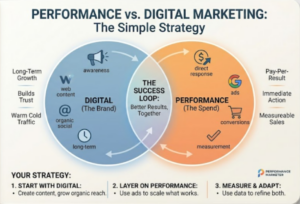
It’s a system where every channel you’re running, Meta, Google, SEO, organic social, and AI search, feeds data into every other channel, compounds your results, and makes each dollar you spend work harder.
Here’s what that actually looks like when it’s working.
The Game Nobody’s Explaining to You
Let’s use Meta Ads as the starting point, because this is where most businesses think the story begins and ends.
You launch a Meta campaign. You get some leads. You measure ROAS. Done, right?
Wrong.
That Meta campaign isn’t operating in a vacuum. It’s being supercharged, or sabotaged, by everything else happening in your digital ecosystem.
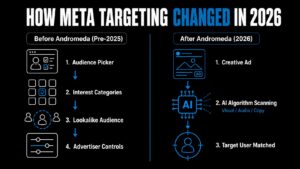
Meta’s algorithm doesn’t just learn from your ad spend.
It’s learning from:
- Every lead coming through your Google Ads
- Your Google Analytics data
- Your SEO traffic patterns
- Word-of-mouth referrals that land on your site
- Your organic social performance
- Even your AI-generated content
All of that user behaviour feeds Meta’s machine learning model. That’s how it knows who to retarget and who looks like your best customers.
Because otherwise, how would Meta know?
You’re not just buying ad placements. You’re feeding an intelligence system.
And that system has 16 million data points on every user.
It’s reading your ad copy, analysing your creative, and cross-referencing user behaviour across platforms. And it’s building a profile of your ideal customer, whether you’re actively optimising for it or not.
Here’s the Bit Most Agencies Miss
When someone sees your Meta ad and clicks through to your site, they don’t just convert and disappear into a spreadsheet.
They become part of your retargeting ecosystem.
Facebook now knows exactly what type of user engages with your brand.
So when you post organic content, whether that’s reels, carousels or stories, Meta’s algorithm serves that content to people who match that profile.
Your paid ads are training your organic reach.
But it doesn’t stop there.
That same user who clicked your Meta ad? They’ve now got a Google Ads tag on them from visiting your website.
Google knows what type of person they are. What they searched for. What they’re interested in.
Google’s going to follow them.
When they search again, whether it’s your brand name or a related keyword, Google is going to show them your ads. Or your organic search results. Or both.
And if they don’t convert immediately? Google’s going to keep showing them remarketing ads across the Display Network, YouTube, Gmail, and every Google property they touch.
The Compound Effect Nobody Tracks
Let’s say you’re a performance marketing agency in Melbourne (hypothetically speaking).
Someone sees your Meta ad. Doesn’t convert.
Three days later, they searched “performance marketing agency Melbourne” on Google. Your local SEO strategy ranks you in the top three. They click through. Still don’t convert.
A week later, they’re scrolling Instagram. Your organic reel pops up because Meta’s algorithm knows they’ve already engaged with your brand. They watch it. Still not ready.
Two weeks later, they’re researching marketing strategies for their business. They type a query into ChatGPT or Google’s AI Overviews. Your content shows up because you’ve been consistently publishing optimised content that AI systems are pulling from.
Now they’re convinced.
They come back, they convert, and your Meta Ads machine learning model registers them as a high-value lead. It adjusts. It finds more people like them.
This is integrated marketing.
Why Your Current Setup Is Probably Broken
Most businesses are running campaigns like this:
- Meta Ads team reports on Meta ROAS
- Google Ads team reports on Google conversions
- SEO team reports on organic traffic
- Social team reports on engagement
Everyone’s claiming credit. Nobody’s seeing the full picture.
Here’s what’s actually happening: your Meta ad is getting credit for a conversion that took five touchpoints across three platforms.
And because your tracking is broken, you’re about to cut the Google Ads budget that was doing half the heavy lifting.
The uncomfortable reality? If you’re not tracking cross-platform attribution, you’re flying blind.
The New Rules (What Actually Works in 2025)
Here’s how the system actually functions when you stop thinking in silos:
- Your paid ads create awareness and feed data to organic algorithms
Meta and Google aren’t separate. They’re symbiotic. Your paid campaigns train your organic reach.
- Your SEO and content create legitimacy that improves ad performance
When someone sees your ad, then Googles you and finds strong organic rankings and quality content, your conversion rate skyrockets. Google calls this “assisted conversions.” Most businesses call it “I don’t know why our ads suddenly started working.”
- AI search is the new word-of-mouth
When someone asks ChatGPT or Google’s AI Overviews, “who’s the best performance marketer in Melbourne,” you’d better be in that answer. Because if you’re not, your competitors are.
- Organic social isn’t a “nice to have”
Your organic content isn’t just for brand awareness. It’s training Meta’s algorithm on who your audience is. Every like, comment, and share is data. That data improves your paid targeting.
- Word-of-mouth and referrals feed the machine
When someone types your URL directly into their browser or clicks a referral link, that behavioural data tells Google and Meta that you’re legitimate. It impacts your ad delivery and your organic rankings.
The Bottom Line
Integrated marketing isn’t about running ads on multiple platforms.
It’s about understanding that every channel feeds every other channel.
Your Meta ads improve your organic reach.
Your SEO improves your ad conversion rates.
Your content feeds AI search results.
Your word-of-mouth legitimises your paid campaigns.
And if you’re not tracking all of it together, if you’re still looking at channel-by-channel reports instead of full-funnel attribution, you’re making decisions based on half the data.
Here’s the reality: businesses that understand this are already three steps ahead.
They’re not asking “which channel works best.” They’re asking, “How do we make every channel amplify the others?”
That’s the difference between throwing money at ads and building a system that compounds.
If you’re ready to stop running siloed campaigns and start building an actual integrated system with tracking that shows you the full story, contact us to talk about what that looks like for your business.