
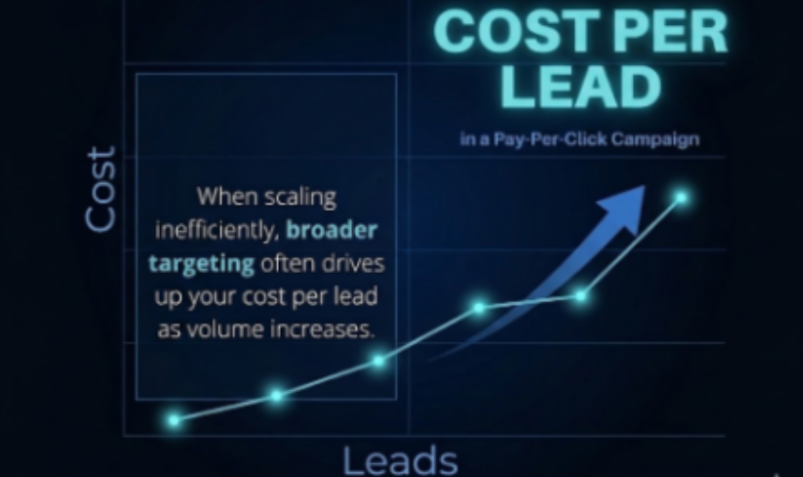
If your Google Ads cost per lead has been climbing while conversions stay flat, the problem is almost never your budget. It’s the structure underneath.
Most accounts we audit have two or three things genuinely broken: campaign architecture, negative keyword hygiene, and landing page alignment, and adding more spend just buys more of the same waste at a slightly worse rate. The work to bring CPL back down is unglamorous. None of it requires switching platforms or chasing the latest bidding feature. But if you do it in order, the numbers usually move within a few weeks.
This piece walks through what’s causing the climb, in the order that matters.
Most Google Ads content online is written for B2B SaaS or e-commerce. Both of those have real problems, but they’re not your problems if you run a trade, a legal practice, or any other local service business.
Click costs are higher. Search intent is more urgent. The cost of a wasted click hurts more because there’s less margin and a smaller volume of qualified searches to work with.
A plumber in Melbourne paying $18 a click for “emergency plumber” can’t afford the same campaign sprawl that a SaaS company gets away with. Family law practices bidding on competitive intent terms are paying $30+ per click in the major metros. At those prices, the difference between a clean campaign and a messy one is often the difference between a profitable account and a money pit.
This is the part most agency content skips. The principles are the same, campaign structure, landing pages, tracking, but the tolerance for sloppiness is far lower at the local services level.
Before any restructure, you need to know where the budget is going. The search term report tells you this in about ten minutes if you know what to look for.
Pull the report for the last 90 days. Sort by cost. Look at the top 30 search terms by spend.
For each one, ask a single question: would someone typing this be ready to hire me?
If the answer is no, or even “maybe”, it goes on the negative keyword list. Most accounts have between 20% and 30% of spend going to terms that fail this test. We’ve seen accounts where half the budget was being spent on informational queries, “DIY drain unblocking”, “what does an electrician charge”, “do I need a will”, that were never going to convert.
This is the search term report audit checklist for Google Ads, and it’s the closest thing in the platform to free money. Block the irrelevant queries, redirect the spend to terms that convert, and your CPL drops without you touching a single bid.
Say if a Melbourne electrician was spending around $4,200 a month on Google Ads with a CPL of $147 and getting low-quality leads, mostly people asking for quotes they’d never accept. The first search term audit identified 31 negative keywords worth adding, including “cheap electrician”, “free electrical advice”, and a handful of suburb names where the business didn’t service. Three weeks later, CPL was $84, and the lead-to-quote conversion rate had nearly doubled. Same budget. Better leads.
That’s how to reduce Google Ads CPL for electricians without losing volume — not by cutting spend, but by stopping the bleed.
Most local service accounts are built around services. One campaign for “drain cleaning”, another for “hot water systems”, another for “emergency callouts”. That’s a reasonable starting point, but it usually breaks down within a few months because nothing accounts for intent.
The same keyword can carry a totally different intent depending on context. “Emergency plumber” at 11 pm is a buyer. “Best plumbers in Melbourne” at 2 pm on a Tuesday is research. They need different ads, different landing pages, and probably different bids.
The best Google Ads campaign structure for lead generation in service businesses tiers campaigns by intent rather than by service alone:
High-intent transactional sits at the top, emergency searches, location-specific service queries, and branded competitor searches. These get the highest bids, the most specific ad copy, and dedicated landing pages built for one action.
Considered intent sits below it, general service queries, where the searcher is comparing options. These ads need to do more work on trust signals (reviews, certifications, response times) because the searcher isn’t ready to commit yet.
Informational stays at the bottom or gets cut entirely from paid search, depending on the budget. For most service businesses, paying to show up against “what does a family lawyer do” is rarely the right use of money. That traffic is better captured organically.
The same structure works whether you’re building a family law Google Ads campaign structure, running ads for an emergency plumber, or setting up paid search for a wills and estate lawyer. The intent tiers don’t change. Only the keywords inside them do.
This is the single biggest lever for reducing cost per lead in Google Ads without cutting volume, and it’s where most service businesses haven’t bothered to look.
Google Ads Quality Score isn’t a vanity metric; it directly determines what you pay per click. A keyword with a Quality Score of 8 can cost you 30-40% less than the same keyword at a Quality Score of 4. The biggest factor inside Quality Score is landing page experience, and when Quality Score starts dropping, the landing page is almost always why.
The standard pattern: ad sends paid traffic to the homepage. The homepage tries to do everything for everyone. Visitor lands, gets confused, bounces. Google notices the high bounce rate on the Google Ads landing page, drops your Quality Score, and your CPC creeps up over the following weeks.
A high-converting landing page for a service business is not complicated. It needs to do four things well.
If the ad says “24/7 emergency plumbing in Brunswick”, the page headline says exactly that. Not “Welcome to Smith Plumbing, Quality Service Since 1994.”
More than 60% of local service searches happen on phones, and even a one-second delay in mobile load time has a measurable effect on conversions. Compress your images. Cut anything you don’t need. Test it on a real phone, not just your desktop preview. Mobile optimisation for Google Ads landing pages isn’t an extra; it’s the floor.
Not five. One form, one phone number visible at the top, one button that does the thing you want them to do.
Real reviews, licence numbers, photos of actual people, accreditations. For trades, this means visible licence and insurance details. For lawyers, it’s professional body membership and case outcomes you’re permitted to share.
In practice, a wills and estate lawyer landing page that opens with “Get your will drafted by an experienced Melbourne solicitor, fixed fee, 7-day turnaround” will outperform “Welcome to our Wills and Estates practice” by a wide margin. The first answers the searcher’s question. The second asks them to keep reading.
That’s the difference between a wills and estate lawyer landing page best practices and a brochure page that happens to live on the internet.
Google’s Smart Bidding strategies, Target CPA, Maximise Conversions, and Target ROAS, can genuinely reduce CPL once your account is structured properly. The mistake we see constantly is switching to Smart Bidding before the foundations are right.
Smart Bidding needs three things to work: at least 30 conversions per campaign in the last 30 days, accurate conversion tracking that’s firing on real leads (not form views), and a campaign structure where the conversion signals are consistent within each campaign.
If any of those are missing, Smart Bidding will optimise toward the wrong signal and your CPL will get worse, not better. We’ve audited accounts where the agency had switched to Target CPA without checking conversion tracking, and Google was bidding aggressively on form submissions that were 40% bot traffic and 30% wrong-number enquiries.
Get the structure right first. Get the tracking clean. Then let Smart Bidding do its job.
If you’re trying to bring your CPL down without losing volume, the order matters more than people think.
Lowest effort, fastest impact. Most accounts see CPL drop 15-25% in the first two weeks just from cutting waste. This is also where the negative keywords for local trade service ads pay for themselves immediately. Most local trade accounts have at least 25-40 negatives they should be running and aren’t.
This takes longer to show results, usually 4 to 6 weeks. because you’re rebuilding the conversion data Google’s algorithms need.
The slowest to implement properly, but the highest ceiling. A landing page conversion rate that lifts from 1.5% to 3% effectively halves your CPL with no other changes. This is also where you’ll see the Google Ads Quality Score recover from any drop tied to landing page experience.
Otherwise, you’re optimising on noise.
Review Quality Scores monthly, fix anything below 6, pause anything below 4.
Sometimes a high CPL isn’t a Google Ads problem at all. It’s a market problem dressed up as one.
If your offer doesn’t resonate with the search intent, if you’re a generalist competing against specialists, or your pricing sits well above the market without a clear reason, no amount of campaign optimisation will fix that. The CPL is telling you something about your positioning, and the cheapest experiment is to fix the offer before throwing more money at the ads.
The other case is structurally tough verticals. Family law in major Australian cities is one. Personal injury is another. CPLs in these markets are simply higher because every competitor knows the lifetime value justifies it. In those cases, the metric that matters isn’t CPL, it’s cost per acquired client measured against client value. A $400 CPL that converts to a $15,000 matter is excellent. A $40 CPL that converts to nothing is a problem, regardless of how cheap it looked.
Always measure CPL alongside what happens after the lead. The number on its own can mislead you in either direction.
The accounts with low CPLs aren’t doing anything magical. They’ve just done the unglamorous work, keyword hygiene, intent-aligned campaigns, landing pages that match their ads, clean tracking, in roughly that order, and they keep doing it as a maintenance habit rather than a one-off project.
If your CPL has been climbing for months and you can’t pinpoint why, the answer is almost always sitting in the search term report or on the landing page. Both are fixable in weeks, not quarters.
The hard part isn’t knowing what to do. It’s making time to do it.
If you’d like an outside read on where your account is leaking, contact us for a no-cost Google Ads audit. We’ll walk through your search term report, campaign structure, and landing page alignment, and you’ll leave with a clear list of what to change first, in the order that will move the needle.
Negative keyword cleanup tends to show up in the data within 1-2 weeks. Landing page improvements take 2-4 weeks to reach statistical significance. Campaign restructuring and Smart Bidding optimisation usually need 6-8 weeks for the full effect, because Google’s algorithms need that long to relearn against the cleaner signal.
Usually not. Cutting spend reduces your data volume, which slows down everything else, Smart Bidding learning, conversion tracking calibration, and the speed at which negative keyword decisions show up in the report. The better move is to keep spending stable and reallocate the wasted portion to terms that already convert.
For most local service businesses with urgent intent (emergency trades, legal services, healthcare), yes, there’s no comparable channel for capturing demand at the moment of search. Where it stops working is when CPLs structurally exceed what the customer lifetime value can support. That’s a unit economics problem, not a Google Ads problem, and it usually gets answered in the offer rather than the ad account.