
If your Meta ads have been getting more expensive and less reliable through 2025 and 2026, the problem is almost never your targeting, your budget, or the platform. It’s the creative.
Meta’s algorithm now reads your ad as the targeting signal. The brands winning in 2026 are the ones building creative diversity, format mix, and a proper testing system. The brands losing are running three good ads from 2024 and wondering why their CPMs doubled.
This is a complete breakdown of what actually works on Meta in 2026, written for Australian ecommerce brands spending $50K to $500K a month and lead generation businesses trying to figure out if Meta is the right channel at all. Backed by the data, structured for fast scanning, and built from $20M+ in spend managed across 200+ campaigns.
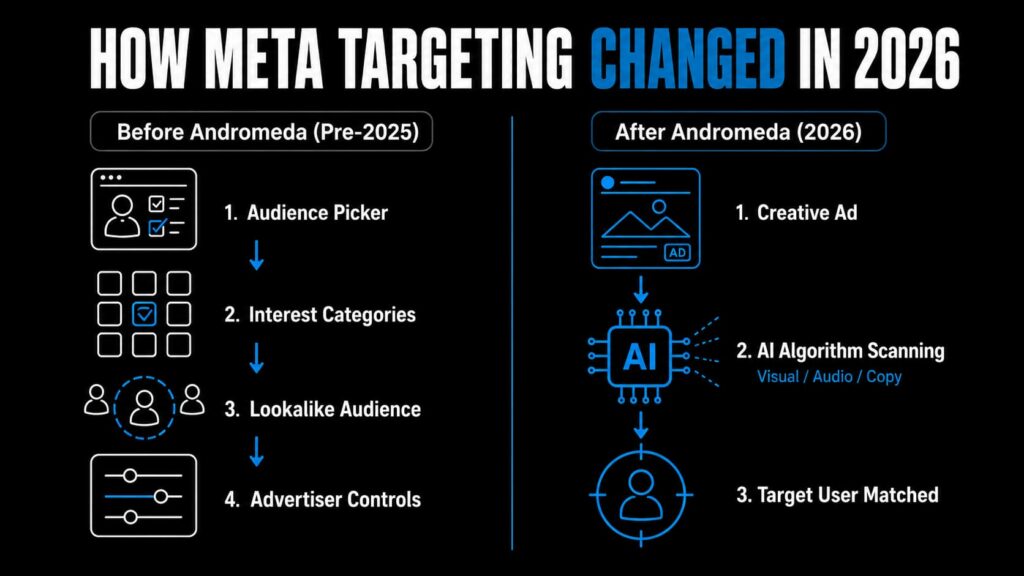
Meta rolled out a new ad delivery system called Andromeda in late 2024, with full global rollout completed by October 2025. Andromeda reads your creative (visuals, audio, copy, hook structure) and decides who sees the ad based on those signals, not based on the audience you selected.
Before Andromeda, your targeting did the heavy lifting. You picked an interest, uploaded ads, and Meta showed those ads inside the box you defined.
Now the system operates as a prediction engine. For every impression opportunity, Meta evaluates:
→ The likelihood a specific person takes the action you care about → The expected value of that action → The predicted quality of the ad experience
The result: your creative is your targeting. If your ad looks like it’s for a 35 year old woman who runs and buys wellness supplements, the algorithm finds her. You don’t have to tell it to.
The practical implication for advertisers is bigger than most realise:
This is the same shift that’s happening in search, where AI search engines now read content differently than traditional Google. Both systems reward depth, diversity, and structural quality over surface-level optimisation tricks. The skills overlap more than people think.
On a pure cost per thousand impressions basis, static image ads are cheaper than video. On engagement, video wins. On conversions, it depends entirely on where you sit in the funnel.
Here are the 2026 benchmarks (ATTN Agency analysis of $47M in ad spend, March 2026):
| Format | CTR | CPM | CPA | Engagement Rate |
|---|---|---|---|---|
| Video Ads | 1.9% | $8.40 | $48.20 | 5.2% |
| Static Image Ads | 1.1% | $3.20 | $34.50 | 1.4% |
A second dataset from StackMatix’s 2026 Facebook performance study confirms the pattern: video ads deliver 15 to 25% lower CPMs than static images on Reels and Stories placements (because video is the native format), but static ads consistently deliver lower CPAs for direct response campaigns on Facebook feed.
For the Australian market specifically, CPMs sit higher than the global average. Tier 1 market data from AdAmigo’s 2026 benchmarks shows Australia averaging $10 to $23 CPM. That puts real pressure on creative efficiency. At $20 CPM, you cannot afford to waste impressions on creative that isn’t doing a job.
The takeaway most advertisers get wrong:
→ Video wins on awareness, engagement, and Reels/Stories placements → Static wins on Facebook feed direct response, retargeting, and budget efficiency → The right ratio in 2026 is roughly 60% video, 40% static for ecommerce, flipping to 70% static, 30% video for most B2B and lead gen
Beauty and DTC brands are running closer to 60/40 static favoured for prospecting (because lower production costs enable faster testing) and 60/40 video favoured for retargeting (because product demonstration matters more once intent is established).
The point isn’t to pick one. It’s to use both in the role they actually win.
After breaking down hundreds of ads across our client portfolio and the ads our team analyses weekly on LinkedIn and YouTube, seven formats consistently hold the highest spend per ad. Here’s what they are and why they work.
A video of the founder or a credible expert (registered nurse, doctor, trades specialist, depending on the vertical) talking directly to camera, captioned, with key claims burned in as graphics.
Why it works in 2026: Andromeda reads spoken transcripts. Founder-led video stacks credibility, authenticity, and personalised pitch into one creative. It also performs across Reels, feed, and Stories with minimal re-editing.
Where it wins: Top of funnel for both ecommerce and lead gen. Particularly strong for service brands and considered-purchase products.
A static image (or screenshot of a tweet, a comment thread, a notes app) paired with primary text of 150 to 250 words that walks the reader through a problem, agitates it, introduces a solution, and closes with a call to action.
Why it works in 2026: On Facebook feed for buyers aged 35 and over, long form copy still converts at rates short video can’t touch. The format also gives Andromeda rich textual signal to match against the right audience.
Where it wins: Cold prospecting on Facebook feed. Especially powerful in supplements, professional services, finance, and B2B lead gen.
A static or short video that names a pattern the buyer already knows: “Onboarding goes great. Then silence.” or “Most EAPs hit 4% utilisation. Yours probably has too.”
Why it works: Pattern naming bypasses the persona callout that everyone is sick of (“Hey ecom brands”). It hits the actual problem the buyer is living with. Specificity drives recognition; recognition drives the click.
Where it wins: Top of funnel B2B lead generation. Highest performing format for SaaS, agencies, and considered-service businesses we manage.
A creator (real customer or paid talent that looks like one) filming on their phone, talking unscripted-feeling content about the product, with native captions.
Why it works: UGC native to the feed feels organic. Meta’s similarity score (which suppresses retrieval for ads scoring above 60%) is naturally low because every creator’s face, lighting, and cadence is different. Each UGC ad gets its own Entity ID.
Where it wins: Top of funnel ecommerce, particularly beauty, supplements, apparel, and pet. Works less well for B2B because the social proof signal needs to come from authority figures, not just real people.
Ads that run through the creator’s or founder’s personal profile rather than the brand page. The handle at the top is “John Smith” or “Dr Jane”, not “Brand Name”. Often shows up as a “John Smith and Brand X” partnership ad.
Why they work in 2026: Two reasons. First, the targeting pool expands to include the creator’s audience, which gives Andromeda more data to optimise on. Second, the ad reads as organic content because there’s no brand page logo at the top. Click-through rates are typically 20 to 40% higher than equivalent brand-page ads on the same creative.
Where it wins: Strong on both ecommerce (creator collaborations) and lead gen (founder personal profile ads). In several accounts we manage, partnership ads now hold 30 to 40% of total spend.
A clean static with one big number (“$120K average claim cost”, “92% increase in 30 days”, “4.1 sessions per user vs 1.8 industry average”) and a tight 30 to 60 word caption.
Why it works: Specificity builds credibility instantly. Numbers are the fastest hook on the platform. Production cost is near zero, so you can test 20 variants for the price of one video shoot.
Where it wins: Bottom of funnel retargeting, lead gen credibility ads, and feed placements on Facebook for older demographics.
A 60 to 90 second video that opens with a contrarian truth or pattern interrupt, problem-agitates, walks through education, then introduces the product or service as the solution near the end.
Why it works: Pulls people through the stages of awareness inside one creative. Particularly effective on cold audiences who have never heard of the product or service. The longer watch time also signals quality to Andromeda, which improves placement.
Where it wins: Top of funnel for considered purchases (supplements with science backing, financial products, complex B2B services).
For ecommerce brands spending $50K to $500K per month on Meta in Australia in 2026, the target format mix is roughly:
This split is built to keep your Creative Similarity Score under 40%, which is the threshold above which Meta’s retrieval engine starts suppressing your delivery (data from admetrics.io’s 2025 analysis).
The split also gives you enough format diversity to reach distinct audiences. UGC reaches younger feed users. Long copy statics reach 40+ Facebook feed buyers. Founder content builds trust on retargeting. Each format covers a gap the others can’t.
A common mistake we see in audits of brands at this spend level: 80% of their ad library is the same format (usually UGC). The account is technically running 60 ads, but Andromeda treats it as five Entity IDs and serves them to the same audience pool repeatedly. Frequency climbs, reach drops, ROAS bleeds out.
The fix is rarely “more ads”. It’s more format types.
The honest answer most agencies won’t give: Meta works for some lead gen businesses, doesn’t work for others, and the difference comes down to three variables.
We work with a lot of lead gen and B2B brands across Melbourne and Sydney. Some scale beautifully on Meta. Others burn through $30K a month and produce nothing usable. Here’s what separates them.
If your business is in the first list and you’ve never properly tested Meta, you might be leaving significant pipeline on the table. If you’re in the second list and you’re spending on Meta hoping it’ll catch up to Google, that’s the conversation we’d rather have honestly. (For context, the pattern we see with Google Ads CPL climbing is structurally similar: most performance problems are channel mismatch, not budget mismatch.)
Lead gen agencies are an unusual case. We work with several. The pattern that works for them in 2026 is:
→ Founder-led content (the agency owner on camera, not a creative team behind a brand page) → Pattern-naming hooks aimed at the specific pain of their target client → Partnership ads through the founder’s personal profile (not the agency page) → Long form copy statics that read like LinkedIn posts, not ad creative → A bottom of funnel retargeting layer with case studies and direct objection handling
The agencies that struggle on Meta are the ones running generic “we do paid ads” content from a brand handle. There’s no differentiation, no signal Andromeda can read, no reason for the algorithm to find the right buyer.
A “concept” on Meta is a combination of three variables: persona, angle, and offer. Change one and you have a new concept. Change all three and you have a different account.
This framework matters because Andromeda reads concepts as targeting signals. If every ad in your account is the same concept (same person, same problem, same value prop), the algorithm targets the same pool of people and frequency spikes within weeks.
Who is this ad specifically for, and who is in the ad.
The mistake: keeping personas too broad. “Busy professionals” is not a persona. “A consultant who flies twice a week and needs a carry-on wardrobe that works for boardrooms and bars” is a persona. The second one writes itself into a script. The first one writes itself into a generic ad nobody pays attention to.
For ecommerce brands, you should be able to list 15 to 20 specific personas across your customer base. Each one becomes a different concept track.
The argument or perspective you’re taking when you speak to that persona.
Strong angles in 2026 typically combine several of these elements:
→ Problem agitation (lead with the pain the viewer already feels) → Contrarian truth (“everything you’ve been told about X is wrong”) → Specific proof (numbers, time frames, named studies) → Curiosity gap (an information gap that only watching the ad closes) → Objection handling (why this works when other things didn’t) → Social proof (specific to the persona, not generic)
The angle isn’t the hook. The angle is the underlying argument the entire ad makes. The hook is just the first three seconds of expressing it.
What you’re actually offering and how you’re packaging value.
Most brands have one offer and run it across every concept. That’s a mistake. In B2B lead gen, the offer should match the angle: a calculator for the ROI angle, a sample audit for the audit angle, a benchmark report for the benchmarking angle. In ecommerce, offer testing (bundles, gift with purchase, tier discounts, subscription) is the second biggest performance lever after the angle.
When you cross-reference 4 angles, 6 personas, and 3 offers, you get 72 potential concepts before you’ve even thought about formats. That’s how you build a creative pipeline that doesn’t fatigue.
80% of viewers never watch past the hook. The hook is not a trick to make people watch. It’s a promise that what follows is relevant to them.
A good hook in 2026 scores well on at least four of these five dimensions:
Hooks that consistently score well in 2026:
→ Pattern naming: “Onboarding goes great. Then silence.” → Contrarian truth: “Insurance, not a perk.” → Specific proof: “One psychological injury claim costs $120K. Five years of prevention costs less.” → Curiosity gap: “What the top 1% of ecommerce brands know about meta ads that you don’t.” → Direct problem agitation: “Stop paying for an EAP nobody uses.” → Pricing transparency: “This product costs $120. Yeah it’s expensive. Here’s why it’s still our best seller.”
Hooks that consistently underperform in 2026:
✗ Persona callouts (“Hey ecom brands…”) ✗ Feature claims with no problem context (“Australian, registered, same-day”) ✗ Brand-led openings (“At BrandCo, we believe…”) ✗ Generic urgency without specifics (“Don’t miss out, limited time”)
A useful diagnostic: if your hook would still make sense if you replaced your product name with a competitor’s, it’s not a hook. It’s a description.
Cold audiences need different creative than warm audiences. The format mix should shift across the funnel.
→ Founder-led video (build trust, deliver education) → UGC style content (feels organic, reaches younger audiences) → Long form copy statics (Facebook feed, 35+ buyers) → Pattern-naming hooks → Educational explainers / VSL-lite formats
Goal: teach, agitate the problem, build authority. Do not sell. Selling on cold to a buyer who isn’t problem aware burns the impression for nothing.
→ Case study / testimonial format → Comparison content (you vs the alternatives) → Educational deep-dives (how the product actually works) → Founder-led “here’s what makes us different” 60 to 90 second pieces
Goal: differentiate. They know they have a problem. Now show them why your solution is the right one.
→ Direct objection-handling statics (price, switching cost, trust) → Big stat or social proof statics → Demo or product walkthrough video (15 to 30 seconds) → Specific offer / discount creative
Goal: close. Already warm. Handle the “yeah but” and push the conversion. Long-form copy statics also work here, but the angle shifts from problem agitation to direct objection.
The transcript that opens up most great Meta accounts in 2026 is recognising that the same buyer needs different creative at different stages. One ad can’t do all three jobs. Most accounts that struggle to scale on Meta are trying to make one creative do all three.
A short list of what to stop doing if it’s still in your account:
→ Dynamic Product Ads scaled aggressively on cold audiences. The attributed ROAS looks great, the incremental ROAS often isn’t. Use DPAs for retargeting where they belong, not for cold prospecting. We’ve seen accounts spend 60% of budget on DPAs based on attributed ROAS, then watch their funnel collapse when the top of funnel volume dries up. → Interest targeting as the primary lever. It’s not dead, but it’s no longer the unlock. Broad targeting + diverse creative outperforms narrow interest targeting in 80%+ of accounts we audit. → Persona-callout hooks. Nobody wants to be called out. They want their problem agitated. → One hero ad holding 80% of spend. Portfolio risk. When it fatigues (and it will, in 2 to 4 weeks under Andromeda), the account collapses. → Production volume without diversity. 2,000 ads a month is not strategy. We’ve audited accounts running this exact play with no profitable result. Volume only works when each ad is meaningfully different at the structural level. → Carousel ads built like brochure pages. Carousels work, but they need to feel like a story or comparison, not a product catalogue. Catalogue Ads belong in their own format pool.
If you want a starting point on what’s costing you elsewhere, the parallel problem in Google Ads CPL climbing and the hidden costs of Performance Max campaigns follow the same pattern: structure problems dressed up as budget problems.
A few things about the Aussie market that affect Meta creative strategy and don’t get covered in US-led content:
Australia is a Tier 1 market. CPMs run $10 to $23 depending on the season and category, with Q4 spiking. The implication: every impression has to do more work than it would in a Tier 3 market. Creative quality matters proportionally more.
We’ve tested this across multiple clients. American or British UGC scripts read native to Aussie creators outperform identical scripts read by US creators by 15 to 30% on conversion. If you’re running Meta in Australia, hire Australian creators or run partnership ads through Australian profiles. The accent is part of the trust signal.
Australian B2B lead gen CPLs run 30 to 50% higher than US equivalents (smaller market, denser competition). At the same time, contract sizes in many service categories run lower. The math gets tight fast. This is why pre-qualification matters more in the Aussie context than the US one. (Same logic applies to Aussie Google Ads spend.)
December to January auction competition spikes. February to March is the cheapest period of the year for most categories. Most Aussie brands plan their creative production cycle wrong and run out of fresh content right when CPMs peak. Better practice: build creative ahead of the November to January window, not during it.
The testing framework that works in 2026 is built on three rules: test concepts (not just creatives), measure at the ad set or campaign level (not the ad level), and let amount spent be your primary signal of performance.
Two ads is not a test. The hit rate on new creative in most accounts is around 5%. To expect a winner from a new concept, you need 10 to 20 ads in that concept. If your testing approach is “let’s try a couple of new ads this month”, you’re not testing, you’re guessing.
Meta’s attribution is last-click. The ad that closes the conversion gets the credit. But Meta’s optimisation is multi-click and multi-view, which means the ad that opened the sequence (the top of funnel asset that warmed the user up) doesn’t get attributed even though it played a critical role.
The fix: stop assessing creative at the ad level. The most reliable signal that an ad is doing real work is whether Meta is distributing more spend to it. If a creative is holding $1,500/day, Meta has decided it’s converting (whether the attribution shows it or not). Trust the spend distribution before you trust the ROAS column.
The campaign level ROAS (7-day click, existing customers excluded) is the most reliable number in Ads Manager. Ad set level is second. Ad level is third. When you’re making decisions, weight the levels in that order. Don’t kill an ad that’s holding spend just because its individual ROAS looks weak.
→ Week 1: Launch 4 to 6 ads in a new concept under one ad set → Week 2-3: Let it learn. Don’t touch it unless it’s clearly broken → Week 3-4: If the concept is winning, build hook variants on the best-performing creatives → Week 5+: Scale by increasing budget or duplicating into a scaling campaign. Never turn off the winner to move it elsewhere.
This is the same testing discipline we apply across paid channels. The underlying performance marketing principles don’t change; the formats and tactics do.
A common question from brands at the $50K to $500K/month Meta spend level: how much of total budget should go to creative production vs media?
The simple answer for 2026:
→ $5K to $30K/month spend: founder-led content, mostly produced internally. Production budget = your time. 60 to 80% of total budget still goes to testing because you don’t have enough scale to scale winners yet. → $30K to $100K/month: 20 to 25% of media budget allocated to production. So at $100K Meta spend, $20K to $25K/month going to creative (UGC creators, designer, editor, light production). This is the level where most brands underinvest. → $100K+/month: 10 to 15% of media budget allocated to production. At this scale you need a full creative team (strategist, editor, designer, 4 to 6 creators) to maintain the volume Andromeda demands.
The biggest mistake we see at all spend levels: treating creative as a cost centre. In 2026, the creative is the revenue driver. The media spend is the distribution. If you’re underspending on production, you’re capping your scaling ceiling on Meta full stop.
For context on what an agency relationship should actually include at this spend level, our breakdown of what a Meta ads retainer should deliver in Australia covers the production vs media split in more detail.
There’s no single best format. Top of funnel ecommerce winners are UGC style video and long form copy statics on Facebook feed. Top of funnel B2B lead gen winners are founder-led talking head video and pattern-naming hook statics. Bottom of funnel across both is direct objection-handling statics and big stat social proof creatives. The right format depends on funnel stage, audience age, and product category, not on a universal ranking.
Video ads deliver 73% higher CTRs (1.9% vs 1.1%) and stronger engagement, but image ads consistently deliver 28% lower CPAs ($34.50 vs $48.20) for direct response. The 2026 data shows video winning awareness and Reels/Stories placements, with static winning Facebook feed direct response and retargeting. The optimal mix for most ecommerce brands is 60% video / 40% static; for B2B and lead gen, flip to 70% static / 30% video.
The benchmark for strong-performing accounts is 15 to 20 active creatives per ad set, with a minimum of 6 distinct concepts. The threshold matters because Meta’s Creative Similarity Score suppresses retrieval for accounts running too many near-identical ads (similarity scores above 60%). For accounts spending $50K+ per month, you typically need 50 to 100 new ads launched per month to maintain performance at scale.
Effective ad lifespan has compressed from 6 to 8 weeks pre-Andromeda to 2 to 4 weeks under the current system. Static ads fatigue 30 to 50% faster than video. Frequency above 2.5 to 3.0 on a creative is the early warning signal; once you hit that, performance typically starts declining within days. The fix is portfolio management (running multiple winners at lower spend) rather than scaling one winner aggressively.
Yes, but only for specific lead gen profiles. Meta works for considered B2B services with clear problem agitation, lifetime values above $5K, sales cycles where nurture matters, and founders willing to appear on camera. Meta usually doesn’t work for transactional urgent-intent services (emergency trades, locksmiths), hyper-local suburb-targeting services, businesses with sub-$2K LTV, or services where the buyer doesn’t know they have the problem yet. For comparison, Google Ads remains stronger for transactional intent in those categories.
For ecommerce, $5K/month is the realistic floor; below that you can’t generate enough conversion data for Andromeda to learn. For B2B lead gen, $8K to $10K/month is more realistic given higher CPLs and 30 to 45 day learning phases (vs 14 to 21 days for B2C). Below those thresholds, the algorithm doesn’t have enough data to optimise effectively, and creative testing becomes impossible.
Generally yes for ecommerce, with caveats for B2B. Advantage+ Shopping Campaigns automate audience selection, creative testing, and budget allocation, and they’ve become the default scaling approach for accounts above $30K/month. For B2B lead gen, Advantage+ Lead campaigns work for high-volume top-of-funnel content but often need to be paired with manual ad sets for specific job titles where creative-led targeting alone produces too much noise.
Critical. Pixel-only tracking now actively penalises your delivery under Andromeda. Conversion signal quality is a factor in retrieval, which means accounts running only browser pixel data are getting suppressed before they hit the auction. Server-side tracking via CAPI with proper event deduplication is no longer optional for accounts running at scale.
Depends on category and AOV, but blended account-level ROAS targets:
What matters more than the absolute ROAS number is incremental ROAS (the lift over a control group not exposed to ads) and MER (Marketing Efficiency Ratio: total revenue / total ad spend). These two metrics tell you whether Meta is genuinely driving growth or just claiming credit for existing demand.
Three signals: (1) MER trends up alongside increased Meta spend (not just Meta ROAS), (2) incremental attribution columns show meaningful lift over the control group (use the Compare Attribution Settings tool in Ads Manager), (3) sales velocity in your store or pipeline visibly responds to ad spend changes within 2 to 4 weeks. If your Meta ROAS looks great but blended business performance is flat, you’re probably claiming credit for organic demand.
For accounts under $10K/month with one product line and one core audience, founder-led DIY is often the right call. The platform’s automation handles most of the technical complexity, and the creative is best produced by the person who knows the customer. Above $30K/month, the production volume Andromeda demands (50 to 100 new ads/month) usually exceeds what a non-specialist can sustain. That’s where agency or internal team support starts paying for itself. Our take on how to evaluate a digital marketing agency in Australia covers what to look for and what to avoid.
Meta in 2026 is harder than it was in 2022, but more powerful for the brands that adapt. The creative is the targeting. The system rewards diversity, format mix, and structural quality. The brands losing money are the ones still running 2024’s playbook with five UGC ads and broad targeting.
The brands winning are the ones building proper concept architecture, testing with discipline, refreshing every 2 to 4 weeks, and treating creative production as the primary growth lever (not an afterthought).
If you’re an ecommerce brand spending $50K to $500K/month on Meta and your performance has been declining, the answer is almost never to spend more. It’s to fix the creative pipeline. If you’re a lead gen business wondering whether Meta is even the right channel, the answer depends on your LTV, sales cycle, and whether your founder will get on camera.
We don’t onboard every brand that asks. We’ve turned down clients where Meta was structurally the wrong channel for their business, because telling them honestly is more useful than taking their money for 12 months and then making excuses. If you want an outside read on whether Meta is the right channel for your business and what’s currently broken in your account, get in touch for a free audit. We’ll walk through your creative library, account structure, and tracking setup, and tell you straight whether to scale, fix, or move budget elsewhere.