
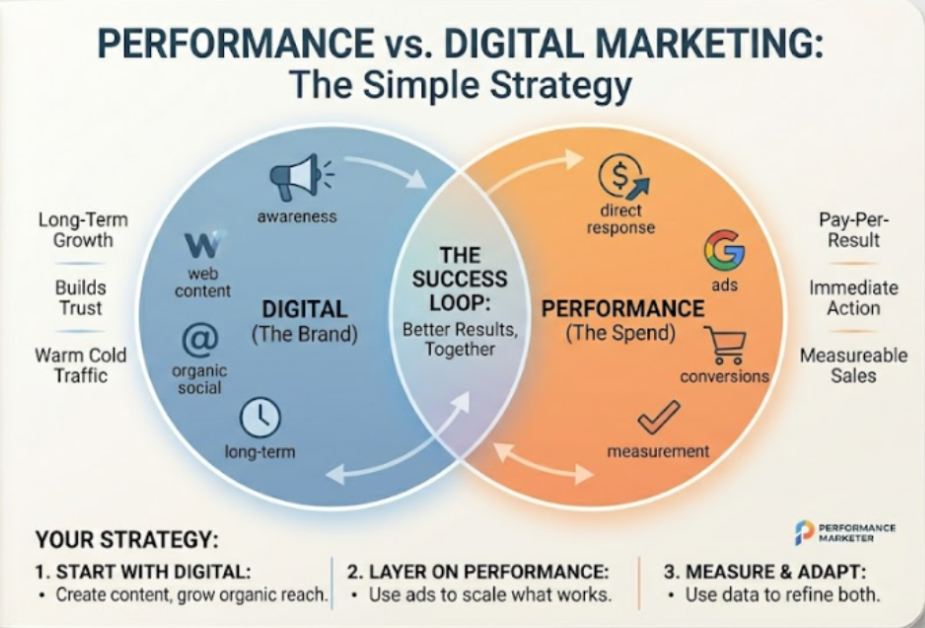
Most people use these two terms interchangeably, and most agencies don’t correct them, because a blurry definition makes a sales pitch easier to deliver. Here is the actual relationship. Digital marketing is the whole field of marketing done online. Performance marketing is one method within that field, and its defining feature is that you only pay when a specific result happens.
That makes performance marketing a subcategory of digital marketing rather than a rival to it. The reason this matters in practice is money. A business that understands the difference will run both and assign each a separate job. A business that doesn’t will usually overspend on one while wondering why the other isn’t working.
When an agency pitches performance marketing as a smarter replacement for the digital marketing you already do, treat it as a positioning choice on their part. It rarely reflects how the two things actually function together.
Digital marketing is a broad category. SEO, content marketing, email marketing, organic social media, paid advertising, anything promotional that lives online belongs to it. The job it does is wide: reaching the right audience, building brand awareness across channels, keeping you present where your potential customers already are.
Performance marketing strips that down to a single principle. You pay only when a defined action is completed, and you pay nothing when it isn’t. Every other digital marketing tactic charges you for the activity itself, whether or not it produces anything. That is the line between the two.
Think of it by what each one answers. Digital marketing answers “where and how should this business show up online?” Performance marketing answers a narrower and more uncomfortable question: did the dollar I just spent come back with something attached to it?
The two genuinely need each other, but they get judged by different numbers, and they pay off on different clocks. That mismatch is responsible for a surprising amount of wasted budget, because owners expect their slow brand-building work to behave like a paid ad, or expect a paid ad to build the kind of trust that only time and content create.
Performance marketing ties spend to measurable results. You aren’t buying visibility and crossing your fingers. You’re buying countable outcomes, and the whole campaign is wired so each dollar traces back to a figure you can check against your own records.
The channels you’ll hear about most are search engine marketing, paid social, PPC and affiliate marketing. Search engine marketing runs paid ads against what people type into Google, so you catch them mid-search with high intent, and you find out within days whether the targeting holds up. Paid social works the opposite way round. On Meta, LinkedIn or TikTok, you’re interrupting people who weren’t searching for you, reaching them by demographic, interest and behaviour, which is powerful but takes more creative work to convert. PPC, or pay-per-click, is the billing model sitting under most of this, where the click is the thing you’re charged for. Affiliate marketing pays out on commission, so a partner or publisher only earns when they actually deliver a lead or a sale.
The metrics are where performance marketing earns its name. Cost per click is the obvious one, though it’s also the most misleading on its own, because a cheap click that never converts costs you more than an expensive one that does. Cost per acquisition is the figure that actually decides whether a campaign is viable, since it tells you what it costs to win one new customer. Return on ad spend frames the same question as a ratio of revenue to spend. Click-through and conversion rate sit either side of the click and tell you whether the problem, when there is one, lives in the ad or on the landing page.
One detail that catches people out: a low cost per click can quietly wreck a campaign if you’ve bought it with broad keyword matching, because Google will happily spend your budget on near-irrelevant searches that click but never buy. The headline number looks efficient while the account bleeds.
Digital marketing is the umbrella, and a lot of what sits under it returns nothing on the day you switch it on.
SEO is the clearest example of the lag. You fix the site, publish content that genuinely answers what people are searching for, and rankings climb over months rather than days. No click fee, but no quick win either. Content marketing carries the same delayed payoff, earning authority and trust well before anyone in that audience is ready to buy. Email keeps you in front of people who already know you, and organic social stops the business from looking like a vending machine.
None of that reduces to “spend a dollar, get a click,” and that is exactly the value of it. You measure digital marketing through traffic, reach, engagement and brand growth, all slower and softer than a conversion count, all slower to turn into revenue. What they build is the one thing performance marketing can’t conjure by itself: a reason for a stranger to trust you in the half-second after your ad loads.
This is probably the most common question we get, and the cause is almost always the same. Performance marketing has been switched on with no digital marketing underneath it.
The breakdown is simple to trace. A paid channel finds someone at the moment of intent and delivers them to your page. If they’ve never encountered your business before, and the page gives them nothing to anchor their trust to, no proof, no clarity, no reason to believe you over the other tab they’ve also got open, they bounce. The click is already paid for. The visit produced nothing because nothing on the receiving end was built to convert a cold arrival.
Businesses rarely lose money on paid ads because their market is fiercely competitive. They lose it by sending paid traffic to pages and brands that give a first-time visitor no reason to act.
That is the precise gap digital marketing fills. Recognition, useful content and visible social proof are what warm a cold click before it lands. Pointing performance spend at no brand foundation means paying top dollar to persuade total strangers from scratch, while the same spend behind a business people already half-recognise does noticeably more work for the money.
A quick myth-check before the technical breakdown, because these four assumptions cause most of the bad decisions we see:
Here’s the side-by-side on the fundamentals:
|
Performance Marketing |
Digital Marketing |
|
|
Goal |
Immediate, measurable actions: clicks, conversions, or sales |
Long-term brand awareness, engagement, and audience relationships |
|
Key metrics |
CPA, ROAS, CPC, conversion rate |
Traffic, reach, engagement, brand growth |
|
Timeframe |
Short-term, fast feedback |
Gradual, compounding over months |
|
Cost model |
Pay only for completed actions |
Upfront investment in content, SEO, and channels |
|
Main channels |
Google Ads, paid social, affiliate, PPC |
SEO, content marketing, email, organic social |
The label on the strategy matters far less than where your business currently sits.
Reach for performance marketing when you need leads or sales on a short timeline, you have a cost-per-lead target you’re actually measuring against, and your tracking is good enough to follow what happens after the click. It rewards tight targeting and fast feedback, which is why it fits a trade business booking local jobs or an online store that has to move stock before the quarter closes.
Digital marketing in its broader sense pays off in different conditions. If you’re launching, breaking into a market that’s never heard of you, or building a reputation more or less from nothing, the brand equity from SEO and content is what you need, even though it won’t show up in next week’s numbers. Over time, it’s also what makes every future paid campaign cheaper to run, because a recognised brand earns a better Quality Score and a lower cost per click on the exact same keywords.
For most Australian businesses, and especially the trades and professional services we work with, framing this as a choice is the mistake. The order is what counts. Get organic visibility and a landing page that actually converts in place first, then put paid campaigns on top to harvest the demand you’ve started generating. The data coming back off the paid side then tells you which content and which search terms to double down on, and the two halves keep feeding each other.
It has real limits, and skipping past them is how businesses talk themselves into bad calls.
The short-termism is structural, not a flaw you can tune out. Chase this month’s conversions hard enough, and you’ll starve the brand-building that produces repeat custom and referrals, so the quarter looks healthy while the business gets weaker underneath it. The model also depends on clean data, which is getting harder to come by as privacy rules tighten and tracking degrades. And the big platforms are crowded, so the keywords worth bidding on cost more every year as everyone piles onto the same auctions.
Some businesses are a genuinely poor fit for it. When the purchase needs a decision and a bit of education first, which is normal in professional services and most of B2B, a “click here now” ad asks for a commitment the visitor isn’t ready to make. Those buyers want content and a reason to trust you before anything else, which lands us back at the main point. Performance marketing does its best work on top of a digital marketing foundation, not as a substitute for one.
If the campaigns are running and the leads still aren’t, spending more is almost never the fix. Check the three things that quietly decide whether any of it works. Look at whether you’re buying genuine search intent or just cheap broad-match clicks that were never going to convert. Look at whether the landing page drives one clear action or leaves people guessing. And look hard at whether your conversion tracking is even accurate, because plenty of accounts make confident decisions on numbers that are silently wrong. Fix those before the budget.
If you can’t tell from the inside whether the trouble is the ads or the missing brand work beneath them, that’s what an outside audit is for. Someone going through where the spend lands and what it brings back will usually find the leak faster than another month of nudging bids and hoping.
The businesses that win aren’t the ones arguing performance marketing versus digital marketing. They run both, and they make each one carry the other.
Performance Marketer is a Melbourne digital marketing agency helping Australian trade, professional services, and small businesses turn their marketing spend into measurable results. If your campaigns aren’t pulling their weight, contact us for an audit.
What is CPM, and does it count as performance marketing?
CPM stands for cost per thousand impressions, so you pay for an ad being shown a thousand times, whether or not anyone clicks or buys. That’s the catch. Since you’re paying for exposure rather than a completed action, CPM sits closer to brand-awareness digital marketing than to pure performance marketing, which only charges you when a measurable result happens. Most marketers treat CPM as awareness spend, not performance.
Which industries are better suited to performance marketing versus digital marketing?
It comes down to how fast someone buys and whether you can trace the sale back to the ad. An emergency plumber bidding on “blocked drain near me” is a near-perfect performance marketing case, because the searcher wants someone that hour and the job either books or it doesn’t. A family lawyer is the opposite. Nobody picks their solicitor off a single click, so that budget does more good on content and brand awareness that earns trust over months.
How do you measure digital marketing if there’s no direct conversion to track?
You watch the inputs that lead to sales instead of the sale. For most businesses, that means organic rankings climbing on the terms worth winning, more of the right people landing on your pages, and longer time spent reading once they get there. Email opens and social engagement fill in the edges. What you’re really reading is the direction of travel over a quarter, because brand-building shifts too slowly to judge from one week.
What does running both digital and performance marketing look like in practice?
In practice, the two operate on a loop. Your SEO and content build the brand awareness and organic traffic that warm people up, then performance campaigns on Google Ads or paid social capture that demand and convert it into leads or sales. The conversion data flowing back tells you which keywords and topics are worth more content. Each side sharpens the other instead of competing for the budget.